या देवी सर्वभूतेषु जातिरुपेण संस्थिता । नमस्तस्यै नमस्तस्यै नमस्तस्यै नमो नमः ॥
(Yā dēvī sarvabhūtēṣu jātirūpēṇa sansthitā । Namastasyai namastasyai namastasyai namō namaḥ)
Translation: To that Divine Energy who resides in all beings in the form of their inherent nature, classification, or division (Jati), salutations to Her, salutations to Her, salutations to Her, again and again.
We must look closely at that word: Jati. In modern times, it has been shrunk and corrupted to mean a rigid, oppressive social caste. But in its pure, ancient context, Jati comes from the root of birth and manifestation. It is the fundamental classification of nature. It is the mathematical sorting of the universe into distinct, functioning species, elements, and roles. As the Shloka reveres, this division is not a human error; it is the very presence of the Divine Energy structuring the cosmos.
How did ancient scholars figure this out without modern telescopes or particle accelerators? They did it by turning their own consciousness into an instrument of quantum measurement.
In modern computing, a classical algorithm searches for an answer by checking one path at a time. A quantum algorithm, however, spreads out, exploring multiple probabilities simultaneously across a vast network of nodes to find the singular truth. The ancient seers operated as human quantum nodes. They expanded their inquiry outward in every direction—mapping astronomy, mathematics, geography, music, and the depths of human neurobiology—and then traced all those diverse paths back inward. They realized that whether you look at the macrocosm of the universe or the microcosm of a single cell, it all collapses back to a single, divine point of origin. At the signal of this profound subtleness—the ultimate Source, which many call God, Atman, or the Singularity—everything exists; without it, everything ceases to be.
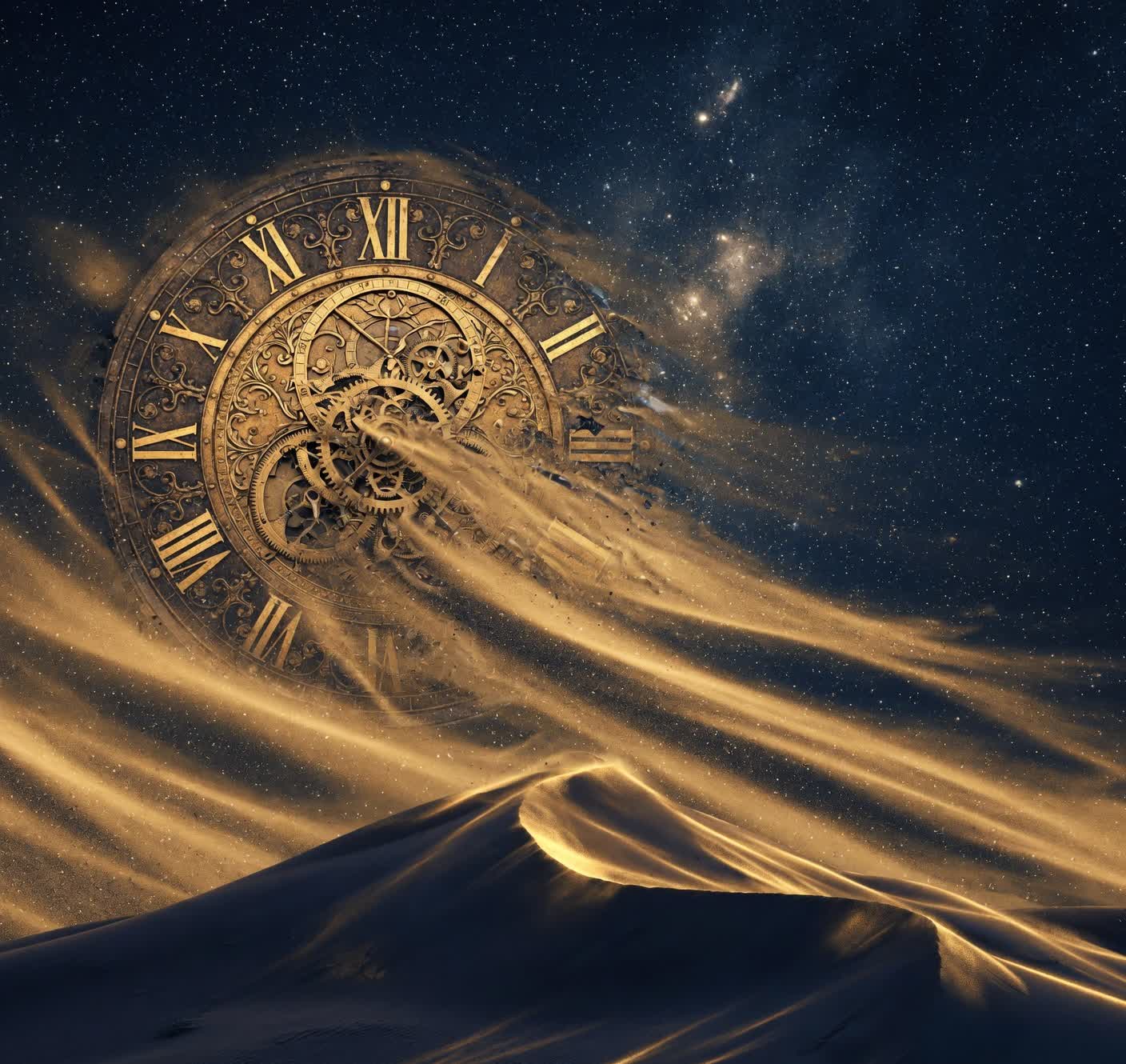
Through this ultimate quantum search, these scholars unlocked one of the most profound truths of the cosmos: time is not a straight line marching toward an end. Time, like the orbits of planets and the life cycles of stars, is entirely cyclic. It operates as a Universal Clock, a self-governing, automated system of expansion and contraction governed by strict mathematical precision.
To make this Universal Clock comprehensible to the human mind, they mapped out the absolute physics of time and systemic entropy into massive epochs. A single grand cycle—a Chatur-yuga (or Mahayuga)—spans exactly 4,320,000 human years.
This grand cycle is not arbitrary; it represents the precise mathematical degradation of order (entropy) in a closed system, divided into four distinct stages:
Satya Yuga (The Golden Age): 1,728,000 years.
Treta Yuga: 1,296,000 years.
Dvapara Yuga: 864,000 years.
Kali Yuga (The Present Age): 432,000 years.
What makes this ancient timeline staggeringly scientifically accurate is that these eras do not snap from one to the next overnight. The scholars understood that massive systems—like global climates, ecosystems, and human consciousness—require deep evolutionary buffer zones to adapt. Therefore, each Yuga contains a "main period" flanked by massive "junctures" (Sandhyas/Sandhyamshas)—dawns and dusks of time where the system gradually recalibrates:
Satya Yuga: 1,440,000 years of peak coherence + 288,000 years of transition.
Treta Yuga: 1,080,000 years of main activity + 216,000 years of transition.
Dvapara Yuga: 720,000 years of main activity + 144,000 years of transition.
Kali Yuga: 360,000 years of main activity + 72,000 years of transition.
To place our current, modern human existence precisely on this massive universal clock: We are currently living in the 28th Chatur-yuga of the 7th Manvantara in the 1st Day of Brahma (Shveta-Varaha Kalpa).
When a new cycle—the Satya Yuga—begins, the universe has just been "reset." In physics, this is a state of minimum entropy. The system is fresh, highly coherent, and perfectly ordered. During this time, everything in nature, including human consciousness, operates by system default. Every organism instinctively knows its function. There is no need for external laws, police, or rigid societal reminders to be mindful, because the energy of creation has just perfectly set the board. No one fights the nature of the system because the system is functioning at peak biological and psychological harmony.
However, the Second Law of Thermodynamics dictates an inescapable rule: in any closed system, entropy (decay and disorder) must eventually increase over time.
As millions of years pass from Satya, through Treta, down to Dvapara, the creative energy finishes its initial burst. The heavy, dissolving energy of Inertia (the decay) begins to seep into the system. As it enters human consciousness, it breeds psychological entropy: fear, greed, deception, and anger. These are not supernatural evils; they are the biological symptoms of a system beginning to lose its initial, perfect coherence.
If left unchecked, this psychological entropy would cause humanity to tear itself apart. This is where the energy of Sustenance activates its greatest defense mechanism: Dharma (Cosmic Order).
Dharma is the ultimate equation for systemic survival. As the internal, default goodness of humanity decays due to the passing of the Yugas, an external structure becomes absolutely necessary to hold the society together. You cannot rely on people to naturally do the right thing in a high-entropy environment like Kali Yuga; you must build a system that guides them to do the right thing.
This is exactly why strict societal divisions and classifications (Jati) were carved out and codified into culture. The division of society into specific, designated roles was not a punishment, nor was it originally an act of oppression. It was a highly calculated, desperate necessity. It was the architectural scaffolding erected by the sustaining energy of the universe to keep the human ecosystem functioning while it navigated the natural decay of the cycle.
From the splitting of quarks inside an atom, to the classification of an entire civilization, division is the solution to chaos. It puts life into a manageable process so that humanity can survive the harshest eras of time, living to the fullest extent possible, until the great cosmic cycle finally completes its rotation. And when that time is up, the entire massive, divided structure neatly collapses back into the singular, unified Atman—resting, resetting, and preparing to begin the beautiful, perfectly ordered cycle all over again.
The Sandhyas: The Friction of a Changing Cosmos Look closely at the structure of the Universal Clock. The transitions between the Yugas are not instantaneous. They contain massive buffer periods—the Sandhyas (dawns) and Sandhyamshas (dusks).
Satya Yuga: 1,440,000 years of peak coherence + 288,000 years of transition.
Treta Yuga: 1,080,000 years of main activity + 216,000 years of transition.
Dvapara Yuga: 720,000 years of main activity + 144,000 years of transition.
Kali Yuga: 360,000 years of main activity + 72,000 years of transition.
In physics, a massive moving object cannot instantly change direction without catastrophic destruction; it requires friction, resistance, and a period of deceleration. The Sandhyas are the friction of the cosmos changing gears. They are periods of immense thermodynamic stress, where the old operating system breaks down to make way for the new.
Modern humanity often reads the ancient Indian epics—the Itihasas and Puranas—and dismisses them as "mythology." But this is a profound mistake of translation. These are not fairy tales; they are serious historical records of these exact transition periods. They document the systemic inertia of the universe, playing out on Earth as historical events.
The Fall from Pure Coherence (Satya to Treta Transition) In Satya Yuga, humanity operated on pure, automated coherence. The earth provided resources without effort. But as the transition into Treta Yuga began, entropy introduced the first wave of inertia. The historical record of this transition is the reign of King Prithu. According to the texts, the Earth stopped yielding her resources freely, and humanity faced starvation. Prithu had to literally "tame" the Earth, inventing agriculture, clearing forests, and establishing the very first physical boundaries and laws of civilization. The Scientific Reality: The environment’s carrying capacity shifted. The cosmic "free energy" decayed, and humans were forced to use physical labor (kinetic energy) to extract sustenance. The system was no longer automatic; it required management.
The Codification of Law (Treta to Dvapara Transition) As Treta Yuga drew to a close, the internal moral compass of humanity degraded further. This dusk period is marked by the completion of the Ramayana and the departure of Lord Rama. Rama is celebrated as the Maryada Purushottam—the supreme upholder of rules and boundaries. The Scientific Reality: Because the innate, biological drive to do the right thing was fading, the universe required an absolute, unbreakable code of conduct to prevent societal collapse. The departure of the ideal administrator marked the end of the era where leaders naturally served the people; from then on, society would struggle with the corruption of power.
The Great Systemic Crash (Dvapara to Kali Transition) This is perhaps the most famous and violent buffer period in human history. The transition from Dvapara into the heavy, dense age of Kali Yuga was marked by the Mahabharata (The Kurukshetra War) and the departure of Lord Krishna. The Scientific Reality: By the end of Dvapara Yuga, psychological and social entropy had reached critical mass. Greed, ego, and the hoarding of resources had paralyzed the human ecosystem. The Kurukshetra War was not just a political battle over land; it was a necessary cosmic release valve. It was the physical manifestation of peak Inertia—a massive, violent clearing of accumulated societal entropy, resetting the board so the dense, low-coherence age of Kali Yuga could begin. The moment Lord Krishna departed Earth is precisely when the cosmic clock clicked into Kali Yuga.
The Ultimate Reset (The End of Kali Yuga) At the end of our current 432,000-year cycle, the texts predict the arrival of the Kalki Avatar and a period of Pralaya (dissolution). The Scientific Reality: This is the thermodynamic endpoint. When a closed system reaches maximum entropy, it cannot sustain itself. The structure must completely collapse, breaking down the corrupted, highly dense energy so it can return to a state of pure, unmanifested coherence—sparking the dawn of a new Satya Yuga.
These historical events prove that human history is not random. Our ancestors were participating in a highly structured cosmic plan. The rise of greed, the necessity of wars, and the birth of societal divisions were all driven by the unrelenting progression of the universal clock.