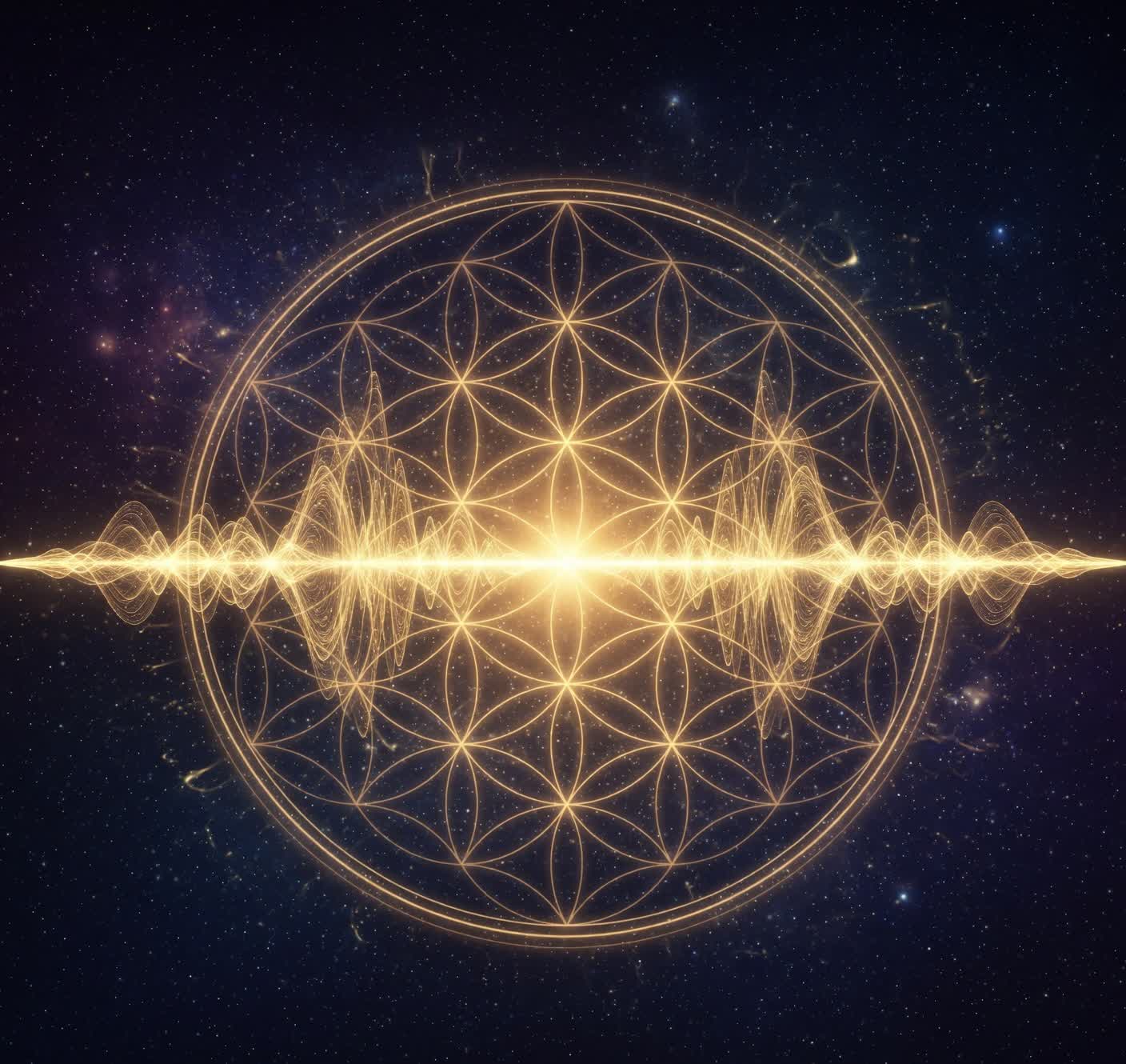
Before the first breath of humanity, before the drawing of borders or the construction of societies, there was only the infinite theater of space. This was not an empty void, but a dynamic, pulsing fabric—a quantum canvas waiting to be awakened. Then came the primordial vibration. It was not a chaotic explosion, but a foundational acoustic wave that rippled through the dense plasma of the infant cosmos. This initial, cosmic hum set the frequency for all that would follow. We are still bathed in its echo today, an ever-present background radiation that whispers the origins of everything.
Think of this not merely as ancient astrophysics, but as the foundational rhythm of your own life. The same rhythmic pulse that governed the early universe echoes today in the beating of a human heart, the involuntary cycle of our breath, and the turning of the seasons. In science, we study this as harmonics and wave frequencies; in ancient texts, it is revered as the first sound; in our daily lives, we experience it simply as the music of being alive. We are not separate from the universe's primordial song; we are living instruments playing its tune.
From that expanding resonance, a silent grace emerged: the organizing principle of the universe. Against the infinite, chaotic pull of entropy, unseen forces began to weave order out of the void. Gravity coaxed scattered dust to gather, clearing the path for stars to ignite and galaxies to spiral. It was this fundamental clearing of cosmic obstacles, this inherent drive toward structure, that allowed the universe to organize itself into a state where life could eventually take root.
This struggle against chaos is something every human understands intimately. Left alone, systems naturally fall into disorder—buildings crumble, paths overgrow, energy dissipates. Yet, life persists because it is the ultimate engine of order. Just as gravity pulled aimless cosmic dust into glowing suns, a similar, profound force drives individual, microscopic cells to cooperate, forming complex organs, functioning bodies, and conscious minds. The very fact that you are alive, breathing, and comprehending these words is a triumph of cosmic order over infinite chaos.
At the heart of this unfolding creation is a perpetual dance between the immutable laws of physics and the restless, creative energy of nature. The silent, unchanging rules of the cosmos provide the framework—the observer—while dynamic matter acts as the creator, forging heavy elements in the fiery hearts of dying stars. Every atom of carbon in our cells, every trace of iron in our blood, was birthed in this ancient union of cosmic law and natural expression.
This is not just a poetic metaphor; it is an undeniable biological reality. The iron that carries oxygen to your brain as you read this sentence was literally forged in the explosive death throes of a supernova billions of years ago. The calcium fortifying your bones, the zinc supporting your immune system—they are ancient cosmic artifacts. When you look at your own hands, you are looking at recycled stars. You are not simply existing in the universe; you are the universe, expressing itself in human form.
We must pause and anchor ourselves in this undeniable reality. Biologically, chemically, and cosmologically, we are all forged from the exact same stardust, vibrating at the exact same quantum frequencies. Before we attempt to untangle the complex web of human societal structures, we must first bow to this shared genesis. To understand how we organized and eventually divided ourselves, we must begin with a clear, unclouded mind, rooted in the absolute scientific truth of our ultimate, unbreakable unity.