ज्ञानिनामपि चेतांसि देवी भगवती हि सा । बलादाकृष्य मोहाय महामाया प्रयच्छति ॥
(Gyānīnāmapi chētānsi dēvī bhagavatī hi sā. Balādākr̥ṣya mōhāya mahāmāyā prayacchati)
Translation: The Great Illusion (Mahamaya) is so powerful that it forcefully draws the minds of even the wisest of beings, casting them into delusion.
We live our busy, modern lives entirely enveloped in this great illusion. The most profound trick nature plays on the human mind is the illusion of fundamental separation. When we look at the complex hierarchies and divisions in our world—the categorization of societies, the variations in human appearance, the splitting of roles—our immediate, flawed instinct is to believe that someone, somewhere, artificially engineered this divide. We fall into the trap of thinking that human hands maliciously fractured a unified world.
But to believe this is to fundamentally misunderstand the core mechanism of the universe. Division is not a human invention; it is the most primal, necessary law of physical and biological expansion.
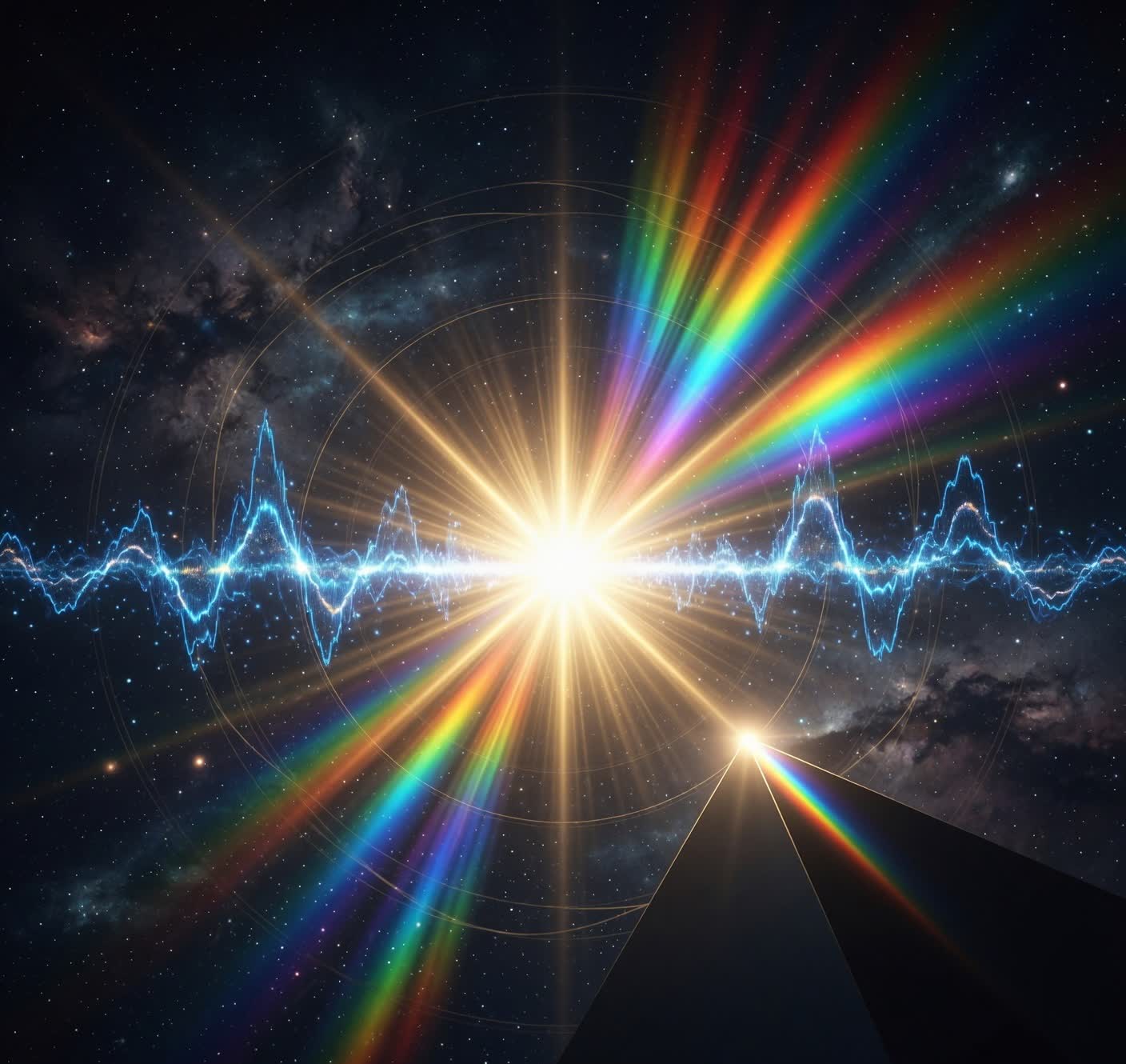
Consider the nature of light. When pure, unified sunlight passes through a prism—or even a simple raindrop in the atmosphere—it bends and fractures, dividing into a brilliant spectrum of colors. The human eye perceives a stark division: red, green, violet. One might easily assume they are entirely different entities, separated by their distinct appearances. Yet, beneath the surface, they are all exactly the same thing: light. The variation in their color is not a change in their fundamental nature, but a simple physical necessity—a minor shift in wavelength and frequency. Nature does not arrange these colors in a hierarchy where blue is superior to red; it requires the entire, diverse spectrum working together to drive photosynthesis, regulate planetary heat, and sustain life. The division is merely an illusion of our perception; the underlying reality is an unbroken unity.
To understand how a unified society eventually categorizes itself, we must look at how life itself grows. A single, microscopic organism cannot grow while remaining a solitary unit. For life to expand, it must do something that seems counterintuitive: it must divide. In biology, we call this mitosis. A single cell duplicates its core information and splits into two. Those two split into four. As this mass of cells grows, they begin to specialize—some become the structural framework of bone, some become the driving force of muscle, some become the intelligence of the nervous system.
This is the very first line of division ever drawn in biology. It is not a fracture; it is a multiplication. Splitting is the root of all creation. Without this division and subsequent specialization, a complex organism—whether it is a human body, a thriving ecosystem, or a sophisticated society—cannot exist. The environment demands varied, specialized roles to maintain harmony.
As this biological and societal expansion unfolds, it does not happen in chaos. It is governed by three underlying natural laws—forces that ancient observers recognized and revered, but which modern science has now codified:
First, there is the Law of Information. For a cell to divide successfully, or for a society to grow, there must be an underlying blueprint—an inherent intelligence guiding the expansion. In biology, this is our DNA. In physics, it is the fundamental constants of the universe. This silent intelligence ensures that as things divide, they do so with purpose and order.
Second, there is the Law of Sustenance. As the system expands, it must be nourished and maintained in a state of balance. Science calls this homeostasis. It is the exact distribution of resources required to keep the varied, specialized parts of the whole functioning in perfect harmony. It is the wealth of nature, providing exactly what is needed for the system to thrive.
Finally, there is the Law of Transformation. As physics dictates, energy can never be created, nor can it be destroyed; it can only change forms. This is the driving force of evolution. It is the restless, dynamic energy that forces adaptation, pushes cells to mutate, and drives societies to evolve. It is the power of constant, unrelenting transaction—the friction that keeps the universe alive and moving forward.
These three laws—the intelligence of the blueprint, the sustaining balance of the ecosystem, and the relentless transformation of energy—are the true architects of expansion. They originate from the exact same source of cosmic truth. When we understand this pure science, our perspective shifts. We realize that the splitting and categorization of life is not a tragedy of human division. It is the most crucial, necessary, and beautiful mechanism the universe has for turning a single pulse of energy into a thriving, complex world.